Concrete walls are not easy to alter once they have been built. When a new doorway, window, service opening or structural modification is needed, simply attacking the wall with heavy demolition equipment can create more work than expected. The surrounding surface may be damaged, debris can spread across the site, and finishing the opening may take additional time.
This is why diamond wall sawing is used on many construction and renovation projects. Instead of breaking concrete apart with repeated impact, the method uses a diamond blade to make a planned cut through the wall. The saw follows a fixed track, helping the operator maintain the required cutting line while working through concrete, reinforced concrete or masonry.
For a project where the size and position of an opening matter, that control can make a real difference. The technique is particularly useful when a contractor needs to remove one defined section without unnecessarily disturbing the material around it.
What Is Diamond Wall Sawing?
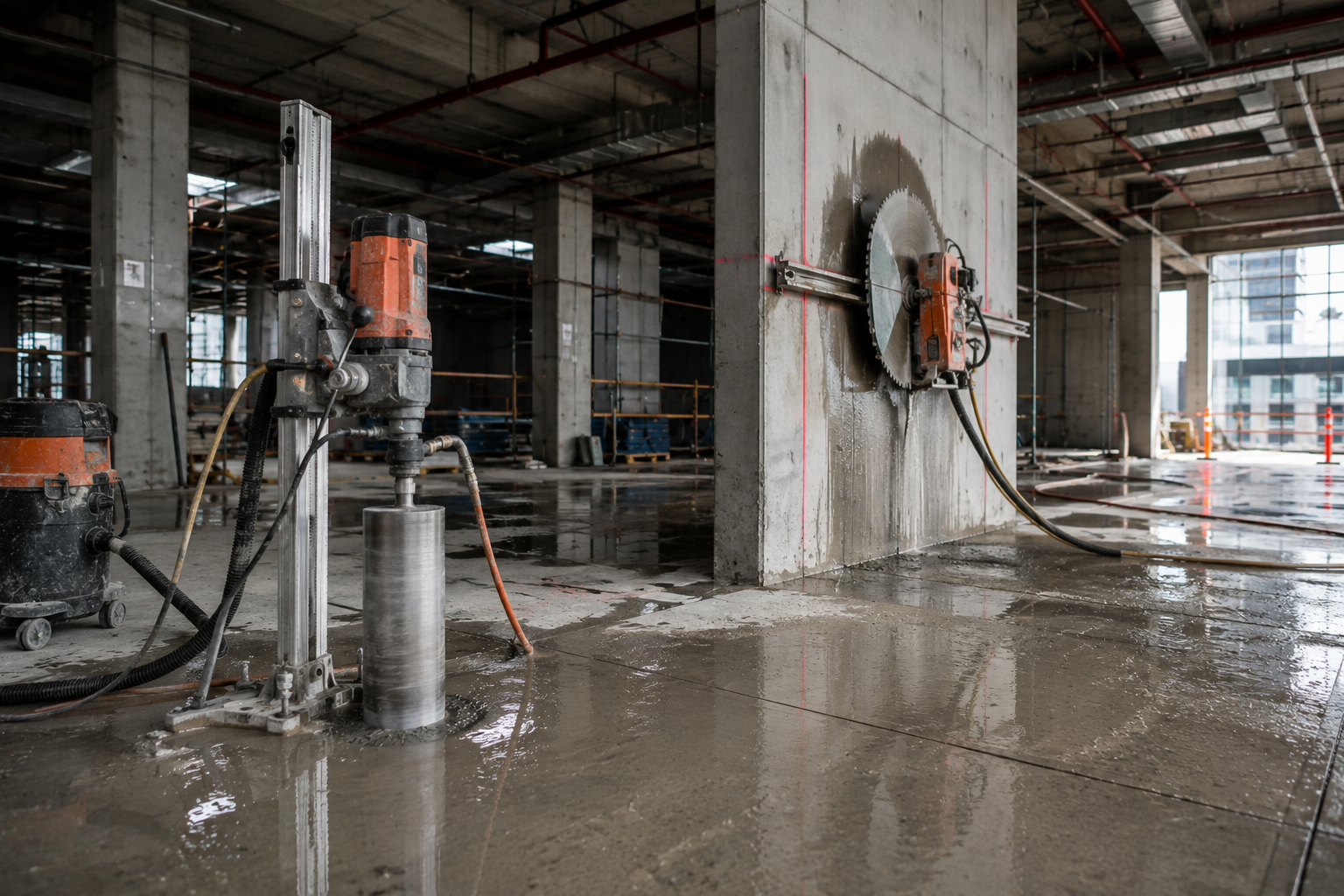
Diamond wall sawing is a specialized concrete cutting method used on vertical, horizontal and angled surfaces. A track is fixed to the wall, and the saw travels along that track while a diamond blade cuts into the material. The equipment is designed to provide a steady and controlled cutting movement.
The diamond segments on the blade are capable of working through tough construction materials. Depending on the project, this can include concrete, reinforced concrete, brick and other masonry products. The cutting depth and equipment selection depend on the material and the dimensions involved.
The method is different from using a handheld demolition tool. Rather than breaking an entire area and working backwards to the required shape, the contractor can establish the intended cut before starting. This makes it useful for openings where accurate dimensions are important.
Why Is Diamond Wall Sawing Used?
There are plenty of situations where concrete needs to be changed after construction. A commercial property may require a new access point, while a homeowner might want to create a larger opening during a renovation. Industrial buildings can also require openings for pipes, ducts, cables or other services.
Using diamond wall sawing allows the contractor to concentrate the cutting action on the planned area. This does not mean that surrounding surfaces are completely unaffected, but it can help avoid the unnecessary breakage associated with uncontrolled demolition.
Another advantage is predictability. Once the wall has been assessed and the cutting line established, the work can be planned around the dimensions of the required opening. That is useful when the next stage of construction depends on the cut being in the correct position.
Common Applications of Diamond Wall Sawing
The technique has applications across residential, commercial and industrial construction. It can be used on existing buildings as well as structures that are still being developed. The right approach depends on factors such as wall thickness, reinforcement, access and the purpose of the cut.
A wall saw may be considered for:
- New door and window openings
- Concrete wall alterations
- Reinforced concrete cutting
- Service penetrations and access openings
- Commercial renovation work
- Industrial structural modifications
- Masonry wall cutting
- Controlled demolition sections
- Openings required for mechanical installations
For larger projects, the cutting work may form only one part of a broader demolition or construction program. The cut itself needs to be coordinated with the people responsible for removing the separated section and preparing the opening for its next use.
How Does Diamond Wall Sawing Work?
The process normally starts with an assessment of the proposed cutting area. The contractor needs to understand what material is being cut, how thick the wall is, whether reinforcement is present and how much room is available around the work area.
The cutting line is then established according to the project requirements. The track is secured to the wall so that the saw has a stable path to follow. Proper setup is important because even good cutting equipment depends on accurate positioning.
Once the saw is ready, the diamond blade begins cutting through the wall in a controlled manner. Water may be used during the process where suitable, helping to manage heat and airborne dust. The number of cuts and the cutting sequence depend on the size and weight of the section being removed.
After the required cuts have been completed, the separated piece still needs to be handled safely. Concrete can be surprisingly heavy, even when a section looks relatively small. Removal and lifting should therefore be considered during the planning stage rather than left until the cutting has finished.
Diamond Wall Sawing Compared With Concrete Breaking
Sawing and breaking are both useful concrete work methods, but they are intended for different situations. A demolition hammer is useful when the main objective is to break material apart quickly. It can be practical for certain demolition tasks where the final edge does not need to be particularly precise.
Diamond wall sawing, on the other hand, is generally selected when a defined cut is required. The blade follows the prepared track instead of relying on repeated impact to fracture the material. This can make the method more suitable for openings that need to follow particular dimensions.
Neither approach should automatically be treated as suitable for every job. The wall, project plans, access conditions and required finish all need to be considered before deciding how the concrete should be removed.
| Project consideration | Diamond wall sawing | Concrete breaking |
|---|---|---|
| Defined opening | Suitable | May require additional trimming |
| Doorway creation | Common application | Possible |
| Window opening | Suitable | Possible |
| Reinforced concrete | Suitable with correct equipment | Possible depending on conditions |
| Controlled cutting line | Strong advantage | Limited |
| Structural modification | Requires proper planning | Project dependent |
| Large demolition area | Usually not the main method | Often practical |
| Edge accuracy | Generally more controlled | May need additional finishing |
| Access requirements | Track and saw setup required | Equipment varies |
| Dust and debris management | Requires planned controls | Requires planned controls |
The final choice should always be based on the individual site rather than on the equipment alone.
Managing Dust During Concrete Cutting
Dust control is an important part of any concrete cutting project. Cutting concrete, brick and similar materials can release respirable crystalline silica, which can present a serious workplace health risk when it is not properly controlled.
Safe Work Australia provides guidance on silica exposure and identifies activities such as cutting concrete and masonry as potential sources of silica dust. Appropriate control measures should be selected according to the work being performed and the equipment being used.
For current Australian workplace information, contractors and site managers can refer to Safe Work Australia’s silica guidance. Water suppression, suitable extraction equipment and appropriate worksite controls can all form part of a dust-management approach. The method used should suit the cutting equipment and conditions rather than being treated as a one-size-fits-all solution.
What Can Affect a Wall Sawing Job?
A concrete wall may look straightforward from the outside, but several factors can change how the work needs to be approached. The contractor should understand these conditions before deciding on the cutting sequence.
Wall thickness is one obvious consideration. A thin masonry wall and a heavily reinforced concrete wall require different equipment and cutting arrangements. Greater depth can also affect the number of passes needed to complete the work.
Reinforcement is another important factor. Steel bars inside reinforced concrete can influence the cutting process and the equipment required. The contractor should know as much as possible about the wall construction before work begins.
Access can also make a difference. A spacious construction site gives the operator considerably more room than a completed building with narrow corridors, furniture, finished floors or other trades working nearby.
Hidden services deserve attention as well. Electrical cables, plumbing and mechanical systems may be concealed within or around existing walls. Their location should be investigated before cutting wherever applicable.
Is Diamond Wall Sawing Suitable for Renovations?
Renovation projects are one of the situations where controlled concrete cutting can be particularly useful. Existing buildings often need to be changed without removing more material than necessary. A new opening might be required while the rest of the structure remains in place.
A properly planned diamond wall sawing job can provide a defined opening for a doorway, window or service installation. The contractor can work from the required dimensions rather than relying on a broad demolition area.
There is still an important distinction between creating an opening and deciding whether an opening should be created. If the wall has a structural function, engineering advice may be necessary before cutting begins. Removing concrete from a load-bearing element without proper assessment can create serious problems.
For this reason, concrete cutting should be coordinated with the relevant plans, engineers and site professionals when the structure requires it.
Preparing a Site for Diamond Wall Sawing
A little preparation before the contractor arrives can save considerable time. The proposed opening should be clearly identified, and the area immediately around the wall should be kept accessible.
It is also useful to discuss the wall construction in advance. If drawings or previous inspection information are available, these can help the contractor understand what may be inside the wall.
The removal plan should be discussed at the same time. Cutting a section out is only part of the job; the separated concrete must then be moved, lowered or disposed of safely. Depending on its size, mechanical lifting equipment may be required.
Water and slurry management should also be considered where wet cutting is being used. The goal is to prevent the cutting process from creating a separate slip hazard, damaging finished surfaces or interfering with other parts of the site.
Why Accuracy Matters
A concrete opening usually has a purpose beyond simply removing material. A doorway needs to accommodate a frame. A window opening has to suit the selected window system. A service opening needs to provide enough room for whatever will pass through it.
This is one reason diamond wall sawing is valuable on construction sites. The cutting path can be marked before work begins, and the track-mounted saw can follow that planned path during the operation.
The final result depends on several things, including site preparation, operator experience, equipment selection and the condition of the wall. Even so, a controlled cutting process gives the project team a clearer starting point for the work that follows.
Choosing a Concrete Cutting Contractor
Choosing a contractor involves more than checking whether they own a concrete saw. The contractor should understand the type of material being cut and the practical conditions of the site.
Before work begins, it is worth discussing the wall thickness, approximate opening dimensions, reinforcement, access, dust management and removal requirements. These details can affect both the equipment and the way the work is scheduled.
For a commercial project, communication can be especially important. Concrete cutting may need to happen between other construction activities, so a clear plan can help minimise disruption.
Conclusion
Changing an existing concrete wall is a job that benefits from careful planning. The cutting method needs to suit the material, the thickness of the wall, the required opening and the conditions around the work area.
Diamond wall sawing provides a controlled way to create openings and remove defined sections of concrete without approaching the entire job as uncontrolled demolition. With suitable equipment, proper preparation and appropriate safety measures, it can be used across many construction, renovation and industrial applications.
If you have a wall that needs to be cut for a doorway, window, service opening or another construction requirement, contact Rapid Sawing & Drilling through the contact page to discuss your project and arrange the appropriate concrete cutting solution.
Frequently Asked Questions
1. What is diamond wall sawing used for?
Diamond wall sawing is used to make controlled cuts through concrete, reinforced concrete, brick and masonry. Common jobs include creating doorways, windows, service openings and sections that need to be removed during construction or renovation.
2. Can diamond wall sawing cut reinforced concrete?
Yes. Suitable diamond wall saw equipment can cut reinforced concrete, although the reinforcement, wall thickness and overall site conditions need to be considered before the work begins.
3. Does diamond wall sawing produce concrete dust?
Concrete cutting can produce dust containing respirable crystalline silica. Dust-control measures should therefore be planned for the particular job. Wet cutting and suitable extraction systems may be used where appropriate.
4. Can wall sawing be used inside an existing building?
Yes. Wall sawing can be used in existing buildings, provided there is sufficient access for the required equipment and the work can be carried out safely. Site protection and water or slurry management may also need to be planned.
5. What information should I provide before requesting wall sawing?
Useful information includes the wall material, approximate thickness, required opening dimensions, location, access conditions and purpose of the cut. Photos, drawings or site details can also help a contractor understand the job before providing advice.