
Concrete floors are built to last, but there are plenty of situations where they need to be modified. Plumbing upgrades, drainage work, electrical installations, expansion joints, renovation projects and controlled demolition can all require precise cuts through an existing slab.
That is where concrete floor sawing becomes useful. Instead of breaking a slab with heavy impact tools, professional sawing creates controlled, straight cuts that help contractors remove or modify specific sections of concrete while limiting unnecessary damage.
The right cutting method can make a noticeable difference to the rest of a project. Accurate cuts can simplify removal, improve access for trades and help keep surrounding areas in better condition. However, concrete is not simply a material that can be cut without planning. Slab thickness, reinforcement, access, existing services and the purpose of the cut all need to be considered beforehand.
For projects requiring accurate concrete modification, understanding how floor sawing works can help property owners, builders and contractors make better decisions.
What Is Concrete Floor Sawing?
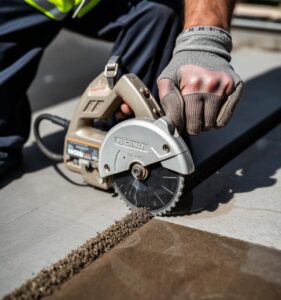
Concrete floor sawing is a cutting technique used to create controlled lines through horizontal concrete surfaces. It is commonly performed using specialized floor saws fitted with diamond blades designed to cut concrete efficiently.
The method can be used on warehouse floors, factory slabs, driveways, car parks, pathways, roads and other horizontal concrete surfaces.
Unlike uncontrolled breaking or jackhammering, floor sawing allows operators to follow a planned cutting line. This makes it particularly useful when only a specific section of a slab needs to be removed.
The required equipment depends on the depth and size of the cut. A professional contractor will normally assess the concrete, determine the required cutting depth and select equipment capable of completing the work accurately.
For broader concrete cutting requirements, you can explore the specialist concrete sawing service to understand how different cutting applications are approached.
Why Is Concrete Floor Sawing Used?
There are many reasons a concrete slab may need to be cut. Most involve installing, repairing or removing something beneath or within the existing floor.
For example, a contractor may need to cut a trench through a warehouse floor before installing new drainage. Similarly, an electrician may require access beneath a slab for electrical conduits.
Floor cutting is also commonly used when creating expansion joints, removing damaged concrete or preparing a section of flooring for replacement.
One of the main advantages is control. Rather than damaging a large surrounding area, the operator can establish a specific cutting path and work within the required dimensions.
This controlled approach can make subsequent excavation and concrete removal more manageable.
Common Applications of Concrete Floor Sawing
Concrete floor sawing can be used across residential, commercial, industrial and civil projects.
Plumbing and Drainage
Plumbing work often requires access beneath existing concrete floors. A carefully planned cut can create a trench for pipes while keeping the removal area limited to what is necessary.
This is especially useful during bathroom renovations, drainage upgrades and commercial plumbing projects.
Electrical Installations
Electrical conduits may need to pass beneath concrete slabs. Floor cutting can provide a defined channel for installation without unnecessarily breaking the surrounding surface.
Expansion Joints
Concrete naturally responds to temperature and environmental changes. Expansion and control joints can help manage movement and reduce the risk of uncontrolled cracking.
Professional joint cutting needs to be completed at the appropriate depth and location for the application.
Concrete Removal
Sometimes only part of a slab needs to be removed. Cutting the perimeter before demolition can create a defined section that is easier to break out and remove.
Industrial Floor Modifications
Factories and warehouses frequently require changes to floors when machinery, drainage systems, services or other infrastructure are installed.
Accurate slab cutting can help contractors modify these spaces while keeping the work area controlled.
Road and Pavement Work
Similar cutting principles are used for concrete pavements and other horizontal surfaces where clean, straight cuts are required before repairs or removal.
What Should Be Checked Before Cutting?
Good preparation is just as important as the cutting itself.
Before starting concrete floor sawing, contractors should consider the slab thickness, reinforcement, surrounding structures and the purpose of the cut.
Existing underground services also deserve particular attention. Cutting into an electrical cable, water pipe or other service can create serious safety risks, costly damage and project delays.
The access available at the site also matters. Large equipment may not be suitable for a restricted indoor location, while larger commercial projects may require machinery capable of completing deeper or longer cuts efficiently.
The cutting depth should also be established before work begins. Cutting too shallow may leave concrete connected beneath the intended line, while unnecessarily deep cutting can create additional risks and increase wear on equipment.
A professional assessment helps determine the most appropriate method.
Bulletin: Key Points to Check Before Floor Sawing
- Identify the exact cutting location before equipment arrives.
- Check the required cutting depth and slab thickness.
- Investigate possible underground services.
- Consider reinforcement within the concrete.
- Confirm equipment access and working space.
- Plan how the cut concrete will be removed.
- Consider water, slurry, dust and site drainage.
- Establish suitable safety controls before work begins.
- Protect nearby surfaces, equipment and workers.
- Make sure the cutting method suits the concrete and project requirements.
These checks may appear straightforward, but overlooking one of them can cause avoidable delays or damage.
How the Concrete Floor Sawing Process Works
Although individual projects differ, professional floor cutting generally follows a planned sequence.
1. Site Assessment
The first step is understanding the work area. The contractor considers the dimensions, access, concrete condition, cutting depth and intended outcome.
2. Marking the Cut
The required cutting lines are measured and marked on the concrete surface. Accuracy at this stage is important because the blade will follow these lines.
3. Equipment Selection
The appropriate saw and diamond blade are selected according to the concrete type, depth and project requirements.
4. Controlled Cutting
The operator guides the equipment along the marked line. Depending on the application, water suppression or suitable dust-control measures may be used.
5. Section Removal
Once the cuts are completed, the defined concrete section can be broken out and removed using an appropriate method.
6. Site Clean-Up
Concrete fragments, slurry and other waste should be managed properly so the area is left ready for the next stage of construction.
This structured approach helps separate the cutting process from the removal process, making the overall work easier to manage.
Concrete Floor Sawing and Silica Dust Safety
Concrete cutting can produce respirable crystalline silica dust, which is an important workplace health and safety consideration.
Safe Work Australia identifies concrete cutting as an activity that can generate silica dust. It recommends appropriate controls such as wet-cutting methods, dust extraction, ventilation and suitable respiratory protection depending on the circumstances.
Wet cutting can also help control airborne dust while supporting blade performance. However, water creates slurry that needs to be contained and managed appropriately.
For Australian workplaces, businesses should follow applicable WHS requirements and assess the risks associated with silica exposure before undertaking dust-generating work.
Safety should never be treated as an optional part of the job. The correct equipment, controls and work practices should be selected according to the actual conditions on site.
SEO-Rich Table: Concrete Floor Sawing Applications
| Application | Why Floor Sawing Is Used | Typical Requirement | Main Benefit |
|---|---|---|---|
| Plumbing trenches | Creates access for pipes and drainage | Accurate linear cuts | Controlled excavation |
| Electrical work | Provides pathways for conduits | Defined cutting depth | Reduced unnecessary damage |
| Expansion joints | Creates planned movement joints | Correct joint placement | Helps manage cracking |
| Concrete removal | Separates the section being removed | Perimeter cutting | Easier demolition |
| Warehouse modifications | Allows changes to existing slabs | Commercial-grade equipment | Efficient floor alteration |
| Car parks | Supports repair and replacement work | Straight surface cuts | Cleaner repair boundaries |
| Industrial upgrades | Creates access for new infrastructure | Detailed site planning | Better project control |
| Pavement work | Defines sections for repair | Suitable saw and blade | Precise removal |
Why Precision Matters
The quality of a concrete cut can influence everything that happens afterwards.
A poorly positioned cut may require additional breaking or repair. An inconsistent cut can make removal more difficult and may create unnecessary damage outside the intended work area.
Precision is particularly important where the existing floor is being retained around the work zone.
For example, if a contractor needs to remove a narrow strip for plumbing, there is little benefit in damaging a much larger section of the slab. A properly planned cut can help keep the affected area closer to the actual requirement.
Precision also makes it easier for following trades to understand the work area. Once the concrete has been removed, plumbers, electricians or other contractors can continue with their part of the project.
Choosing the Right Concrete Cutting Contractor
Not every concrete cutting job is the same. Before choosing a contractor, consider their experience with similar applications and the equipment available for the project.
It is also worth discussing the cutting depth, slab condition, access restrictions and expected completion requirements before work begins.
A reliable contractor should be willing to assess the site rather than simply providing a generic cutting approach.
Communication matters too. If several trades are working on the same project, the cutting schedule needs to fit around excavation, service installation, concrete removal and reinstatement.
You can also review the contractor’s broader service information through the home page before discussing your project requirements.
When Should You Arrange Professional Floor Cutting?
Professional assistance is generally worthwhile when the concrete is thick, reinforced, difficult to access or connected to important infrastructure.
It is also sensible to seek specialist assistance when the cut needs to meet precise measurements or when dust, slurry, noise and site safety need to be managed carefully.
Trying to complete demanding concrete cutting without the correct machinery can lead to slow progress, uneven cuts, equipment damage or unnecessary surface damage.
Professional operators have access to purpose-built equipment and can select a cutting method according to the specific site.
Conclusion
Concrete floor sawing provides a practical way to modify existing slabs for plumbing, electrical work, drainage, expansion joints, repairs and controlled concrete removal. Its biggest advantage is the ability to create defined cuts without relying entirely on uncontrolled demolition.
However, successful floor cutting depends on more than simply running a saw across a slab. The concrete thickness, reinforcement, underground services, equipment access, cutting depth and safety requirements all need to be considered before work begins.
Dust and silica exposure should also be taken seriously, with appropriate controls used for the conditions on site.
If you need accurate and professionally planned concrete floor sawing, contact Rapid Sawing & Drilling to discuss your project requirements, cutting depth, site conditions and preferred timeframe. A proper assessment can help you choose the right approach and keep the next stage of your project moving smoothly.
Frequently Asked Questions
1. What is concrete floor sawing used for?
Concrete floor sawing is used to create controlled cuts in horizontal concrete surfaces. Common applications include plumbing trenches, electrical conduits, expansion joints, concrete removal, repairs and industrial floor modifications.
2. Can concrete floor sawing be used on reinforced concrete?
Yes. Specialized diamond cutting equipment can be used for reinforced concrete, although the appropriate equipment and cutting method depend on the slab thickness, reinforcement and project requirements.
3. Does concrete floor sawing create dust?
Concrete cutting can generate silica-containing dust. Suitable control measures, including wet cutting or dust extraction, should be selected according to the work conditions and applicable WHS requirements.
4. How deep can a concrete floor be cut?
The achievable cutting depth depends on the equipment, blade, concrete thickness and site conditions. A professional contractor can assess the slab and determine an appropriate cutting method.
5. Why should I use a professional concrete cutting contractor?
Professional contractors have specialized equipment and experience in planning controlled cuts. They can assess access, concrete thickness, reinforcement, services and safety considerations before beginning the work, helping reduce unnecessary damage and delays.