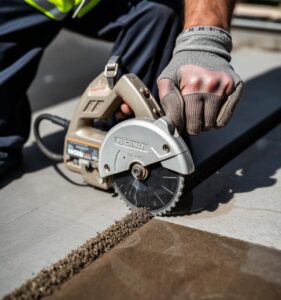
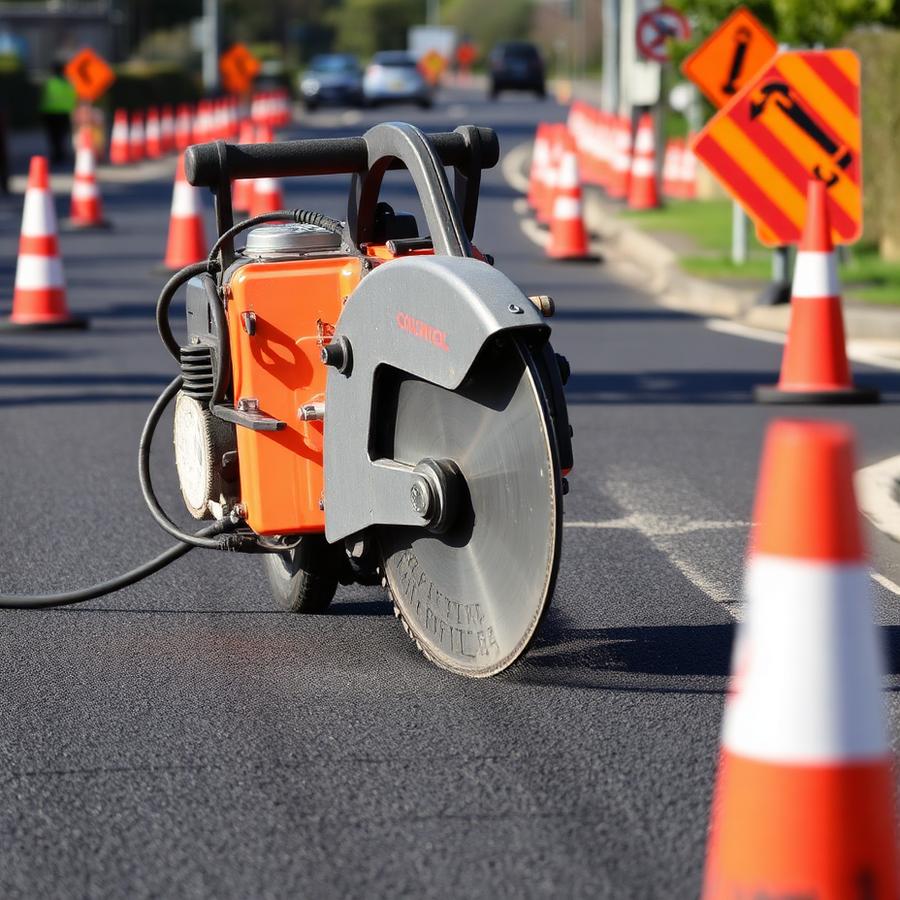
For contractors, councils, builders and utility crews, the goal is straightforward: make a controlled cut, remove only the material that needs to be removed, and keep the surrounding pavement as sound as practical. Good preparation also helps crews coordinate excavation, drainage, pipe installation, electrical work and repairs without creating unnecessary disruption.
What Is Road Sawing?
Road sawing is the controlled cutting of asphalt, concrete pavement or similar hard surfaces with specialised saws. The cut may mark the edge of an excavation, create a trench for services, separate damaged pavement, form an expansion joint or prepare a section for removal.
Unlike rough breaking with a jackhammer, sawing creates a defined line. This matters when a contractor needs predictable edges for reinstatement. A straight cut can also reduce the amount of surrounding material that has to be disturbed. The exact equipment and blade are selected according to the surface, required depth and site conditions. Road sawing needs careful planning.
Road sawing is commonly associated with civil construction, utility installation and road repairs, but it can also be useful around driveways, car parks, footpaths and private access areas. The same principle applies: identify the cutting line, understand what lies beneath it, select suitable equipment and complete the work with proper site controls.
Where Is Road Sawing Used?
There is no single type of project that calls for road sawing. It is useful whenever a hard surface needs to be opened in a controlled way. Utility contractors may need a narrow cut before installing or repairing underground services. Civil crews may use it when repairing pavement or preparing a section for replacement.
Road sawing can also support drainage work, telecommunications installation, kerb modifications and access improvements. On private sites, it may be required for driveway changes, car park repairs or service connections. The cutting pattern should always match the planned excavation or repair rather than being decided after the saw arrives.
Some common applications include:
- Service trenches for water, drainage, electrical and communications work
- Pavement repairs where damaged sections need defined edges
- Road and asphalt cutting before excavation
- Expansion or control joint preparation in suitable concrete surfaces
- Driveway, car park and access-way modifications
- Preparation for utility upgrades and infrastructure installation
The benefit is not simply speed. A planned cut can make the next stage of construction easier to measure, excavate and reinstate.
Why Accurate Cutting Matters
A pavement surface is part of a larger system. When an unnecessary area is broken or damaged, the repair can become larger than the original job. Accurate cutting helps the crew establish a clear boundary and can make removal more manageable.
Precision is especially important where the work is close to existing kerbs, structures, services or finished surfaces. The operator needs to consider the required depth and the condition of the pavement before starting. Cutting too aggressively may create avoidable damage, while cutting too little can leave the excavation incomplete.
Another consideration is the quality of reinstatement. If the edges are irregular, the repair may be harder to compact and finish neatly. A controlled cutting line gives the following trades a more predictable working area and can help the finished repair blend with the surrounding pavement.
Choosing the Right Sawing Method
The surface and project requirements should guide equipment selection. Asphalt behaves differently from reinforced concrete, and a shallow repair cut has different needs from a deep service trench. Access also matters. A large machine may be efficient in an open road but impractical in a restricted area.
The operator should consider the required cutting depth, pavement thickness, reinforcement, access, water supply, spoil management and nearby structures. The planned excavation should also be understood before cutting begins. This prevents the cutting pattern from being based on guesswork.
For larger civil jobs, planning should include the sequence of traffic control, cutting, excavation, service work, backfilling and reinstatement. When those steps are coordinated, the cutting crew can work more efficiently and other contractors are less likely to wait for access.
Safety, Traffic and Dust Considerations
Road work creates risks beyond the cutting machine itself. Workers may be exposed to moving vehicles, mobile plant, dust, noise, water, slurry and underground services. Safe Work Australia identifies work on or next to a public road as high-risk construction work and states that suitable traffic management and a safe work method statement are required in applicable circumstances.
Dust also deserves attention. Cutting concrete and similar materials can generate respirable dust, so the control method should be selected before work begins. Wet cutting, suitable extraction and appropriate respiratory protection may be relevant depending on the material and task. Workers should follow the applicable site risk assessment, equipment instructions and WHS requirements.
Traffic controls should suit the location and work duration. Depending on the project, controls can include barriers, cones, signs, speed restrictions, pedestrian separation or traffic controllers. Public-road work may also require coordination with the relevant road authority.
How to Prepare Before the Crew Arrives
A small amount of preparation can prevent a surprisingly large amount of wasted time. The client or site supervisor should make sure the work area is accessible and that the crew can reach the cutting location with the required equipment.
The following details are worth confirming before the booking:
- Exact cutting location and approximate dimensions
- Surface type and estimated thickness
- Required cutting depth and purpose of the cut
- Known underground services and site drawings
- Access restrictions, working hours and traffic conditions
- Water, power or other site requirements where applicable
- How removed material, slurry and spoil will be managed
- What trade or contractor will take over after cutting
Clear information helps the contractor choose an appropriate method and arrive prepared. It also reduces the chance of stopping halfway because an important site condition was overlooked.
Factors That Affect Road Sawing Cost
There is no useful single price for every road sawing project. The final cost can depend on several practical factors. Cutting depth and total linear metres are obvious considerations, but they are not the only ones.
Surface type affects blade selection and cutting performance. Reinforced concrete can require a different approach from asphalt. Restricted access can increase setup time, while traffic control requirements can add labour and planning. Work outside normal hours may also have different scheduling implications.
The condition of the pavement matters too. If the surrounding surface is already badly cracked or unstable, the cutting plan may need to account for additional removal and reinstatement. Waste handling, water management and mobilisation can also affect the overall scope.
A useful quote should therefore be based on the actual job rather than a generic rate. Providing photographs, dimensions, location details and the purpose of the cut can help a contractor assess the work more accurately.
Quick Comparison of Common Cutting Needs
| Project need | Typical cutting approach | Main consideration | Next stage |
|---|---|---|---|
| Utility trench | Linear pavement cutting | Depth and service location | Excavation |
| Road repair | Defined pavement cut | Repair boundary | Removal and reinstatement |
| Concrete slab work | Slab sawing | Thickness and reinforcement | Breakout or construction |
| Circular service opening | Core drilling | Diameter and depth | Pipe or conduit installation |
| Vertical opening | Wall sawing | Wall structure and access | Installation or modification |
This comparison is only a starting point. Site conditions can change the appropriate method, so the final approach should be confirmed by the contractor after reviewing the project.
How Road Sawing Supports Better Reinstatement
The job does not finish when the saw stops. In many projects, the quality of the final repair depends on how well the initial cut, excavation and reinstatement are coordinated. A controlled boundary can help the repair team understand exactly which section has been removed and where the new material should finish.
The excavation should be carried out without unnecessarily undermining the pavement that is staying in place. After the required underground work is completed, backfill and compaction need to follow the relevant project specifications. The surface can then be reinstated to suit the road or pavement design.
Good communication between the cutting crew, excavation team and reinstatement contractor is valuable. If each stage is planned separately, the project may lose time through rework or access conflicts. When the sequence is agreed beforehand, the work can move from cutting to excavation and repair with fewer surprises.
When Should You Hire a Professional?
A professional cutting crew is usually the sensible choice when the pavement is thick, reinforced, difficult to access or located near traffic and services. Specialist equipment allows operators to make controlled cuts while working within the constraints of the site.
Professional assistance is also useful when the project has strict dimensions or when the cut forms part of a larger civil, drainage, electrical or construction program. An experienced operator can assess the surface, cutting requirements and access before selecting the equipment.
DIY cutting may appear simple on a small patch of pavement, but heavy saws, dust, slurry, noise and hidden services create risks that are easy to underestimate. The cost of correcting a poor cut or damaged surrounding pavement can quickly outweigh the saving from doing the work without specialist help.
Final Thoughts
Road sawing is a practical way to create controlled openings and defined pavement boundaries without unnecessarily disturbing the surrounding surface. Its value comes from precision, planning and choosing a cutting method that suits the material and the job.
Before work starts, confirm the cutting line, depth, underground services, access and traffic arrangements. Think about what happens after the cut as well, because excavation, service installation and reinstatement are all connected.
If your project requires related concrete work, you can review the available concrete cutting and drilling services before arranging the job. For a project-specific assessment, contact Rapid Sawing & Drilling to discuss the scope and timing before booking.
FAQs
1. What is road sawing?
Road sawing is used to make controlled cuts through asphalt or concrete pavement. Common applications include service trenches, road repairs, utility installation, drainage work, driveway modifications and preparation for pavement removal.
2. Can road sawing be used on asphalt?
Yes. Suitable equipment and blades can be used for asphalt cutting. The cutting method depends on pavement thickness, condition, required depth and the purpose of the work.
3. How deep can road sawing go?
The achievable depth depends on the equipment, blade size and surface being cut. The required depth should be confirmed during project planning rather than assumed from a standard measurement.
4. Is road sawing suitable near traffic?
It can be, but work near traffic requires proper planning and controls. Traffic management, pedestrian separation, signage and other measures should be selected according to the site and applicable WHS requirements.
5. How do I arrange road sawing for a project?
Start by providing the location, surface type, approximate dimensions, required depth, access conditions and purpose of the cut. You can then discuss the scope and timing with a cutting contractor and request a project-specific assessment.