How deep can a concrete saw cut? In a single pass, most professional flat saws cut between 100 mm and 450 mm deep, depending on blade diameter, engine power, and the number of passes used. Handheld angle grinders typically reach 40–65 mm, while large walk-behind slab saws with 900 mm blades can exceed 400 mm in a single run.
If you’re planning a renovation, cutting a control joint, or opening up a slab for plumbing or electrical work, understanding cut depth is the single most important variable in choosing the right equipment and method. Get it wrong and you’ll either damage reinforcing steel, blow out your budget on multiple passes, or undercut a structural element you didn’t intend to touch.
This guide walks you through every type of concrete saw, realistic depth limits, cost factors, and when a job genuinely needs a professional crew rather than a hire-centre machine.
What Types of Concrete Saws Are Used in Australia?
Before you can answer how deep a concrete saw can cut, you need to know which saw you’re talking about. The term “concrete saw” covers several very different machines, each with its own depth ceiling.
- Handheld angle grinder with diamond blade: Common for small cuts, expansion joints, and tile work. Maximum depth is roughly 40–65 mm depending on blade diameter (typically 115 mm to 230 mm).
- Handheld cut-off saw (petrol or electric): Uses 300–350 mm blades. Practical cutting depth sits around 100–125 mm in a single pass.
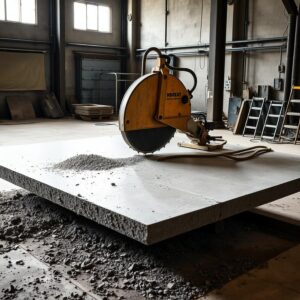
- Walk-behind flat saw (floor saw): The workhorse of slab cutting. Blade sizes range from 350 mm to 900 mm, giving cut depths from roughly 120 mm up to 450 mm.
- Wall saw (track saw): Mounted on a rail system, wall saws can cut vertically or at angles to depths exceeding 600 mm, making them the go-to for thick retaining walls and deep beams.
- Wire saw: Used for extremely thick or irregular concrete structures — bridges, dam walls, foundations — where depth is essentially unlimited.
- Ring saw: A specialist tool with a blade on the outer ring rather than a central arbor, allowing cuts up to 270 mm deep from a relatively compact machine.
For most residential and light commercial work in Australia — think driveways, footpaths, warehouse floors, and domestic slabs — the walk-behind flat saw is the standard choice, and it’s the machine most people are asking about when they search for cut depth information.
How Deep Can a Concrete Saw Cut with Different Blade Sizes?
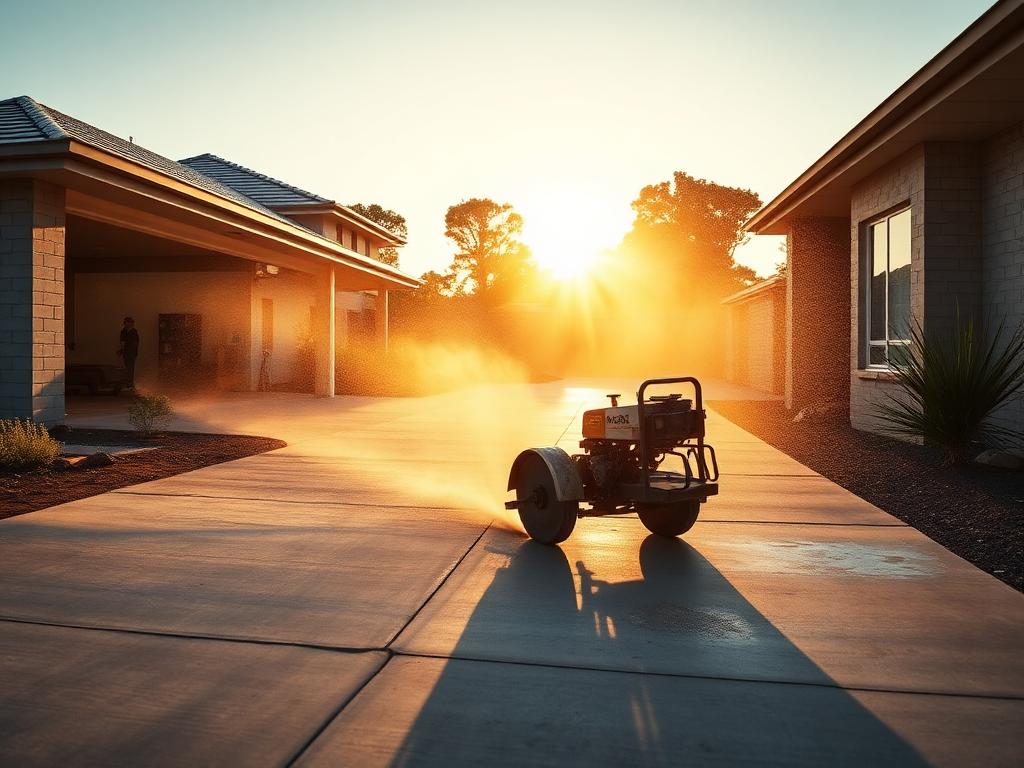
Blade diameter is the primary determinant of maximum cut depth. As a rule of thumb, a diamond blade cuts to roughly half its diameter, because the blade guard, arbor housing, and spindle take up the other half. That means a 400 mm blade gives you around 180–200 mm of usable depth, not 400 mm.
| Blade Diameter | Typical Machine Type | Max Cut Depth (Single Pass) | Common Application |
|---|---|---|---|
| 115–230 mm | Handheld angle grinder | 40–65 mm | Tile removal, shallow joints, surface scoring |
| 300–350 mm | Handheld cut-off saw | 100–125 mm | Control joints, thin slabs, pavers |
| 400–500 mm | Walk-behind flat saw (small) | 150–200 mm | Domestic slabs, driveways, footpaths |
| 600–700 mm | Walk-behind flat saw (medium) | 250–300 mm | Commercial floors, road work, thick slabs |
| 800–900 mm | Walk-behind flat saw (large) | 350–450 mm | Industrial slabs, deep road cutting, bridge decks |
| 900 mm+ | Wall saw / wire saw | 600 mm+ | Retaining walls, foundations, structural demolition |
Keep in mind these figures assume a well-maintained, correctly specified diamond blade matched to the concrete hardness. Using the wrong blade segment type — say, a soft-bond blade on hard aggregate — will reduce both depth and blade life significantly.
Can You Cut Deeper by Making Multiple Passes?
Yes, absolutely. Multiple-pass cutting is a standard industry technique when a single pass won’t reach the required depth, or when you want to reduce stress on the blade and machine. The process involves setting the blade to a shallower depth for the first pass, then increasing depth incrementally on each subsequent run along the same cut line.
This approach is particularly useful when cutting through reinforced concrete, where rebar can cause blade deflection or binding if you try to push through the full depth in one go. Taking two or three shallower passes reduces heat build-up, extends blade life, and gives the operator better control over line accuracy.
The trade-off is time and cost. Each additional pass adds to the job duration, which matters if you’re paying for equipment hire by the hour or engaging a contractor on a day rate. For most domestic slab work — a standard 100 mm unreinforced slab — a single pass with a correctly sized machine is all that’s needed. For 150–200 mm reinforced slabs, two passes is common practice.
What Factors Affect How Deep a Concrete Saw Can Cut?
Blade diameter is the starting point, but several other variables influence the depth you’ll actually achieve on site.
- Engine or motor power: Underpowered machines bog down in hard concrete, forcing you to reduce depth to keep the blade spinning at an effective speed. Professional petrol flat saws run 20–35 HP engines for good reason.
- Concrete hardness and aggregate type: High-strength concrete (40 MPa and above) puts far more wear on a blade than standard 25 MPa residential mix. Harder concrete means slower cutting and more frequent blade dressing.
- Reinforcing steel (rebar): Cutting through rebar is possible with the right blade, but it dramatically increases wear and can cause blade wobble that reduces effective depth. Always locate rebar with a cover meter or GPR scan before cutting.
- Blade condition: A glazed or worn diamond blade cuts shallower and slower than a fresh blade. Dressing the blade on a soft abrasive material (like sandstone or green concrete) restores cutting performance.
- Water cooling: Wet cutting allows the blade to run faster and deeper without overheating. Dry cutting is limited to shorter, shallower runs to prevent blade distortion and dust hazards.
- Operator experience: An experienced operator reads the machine’s behaviour and adjusts feed rate and depth accordingly, protecting both the blade and the cut quality.
How Much Does Concrete Cutting Cost in Australia?
Concrete cutting costs in Australia vary based on cut depth, slab thickness, reinforcement, access, and location. Here’s a realistic breakdown for 2026.
Most contractors charge either a per-lineal-metre rate or a minimum call-out fee, whichever is higher. Minimum call-outs typically start at $200–$350 for metropolitan areas. For larger jobs, per-metre rates apply.
- Shallow control joint cutting (up to 50 mm deep): $8–$15 per lineal metre
- Standard domestic slab cutting (100 mm, single pass): $15–$30 per lineal metre
- Reinforced slab cutting (150–200 mm): $30–$60 per lineal metre
- Deep industrial or road cutting (300 mm+): $60–$120+ per lineal metre
- Wall sawing (vertical cuts, 200–600 mm deep): $80–$150+ per lineal metre
These figures are guides only. A job with difficult access, post-tensioned concrete, or hazardous materials like asbestos-containing render will carry additional costs. Always request a site-specific quote. For professional concrete cutting in Melbourne, getting a detailed quote before work starts is standard practice.
Can You Cut Concrete Yourself, and Should You?
For shallow, non-structural cuts — scoring a line for a garden edge, cutting a control joint in a new path, or removing a small section of a thin slab — a hire-centre cut-off saw or angle grinder can do the job if you follow safe work practices. Wear a P2 respirator, eye protection, and hearing protection. Wet cutting is strongly preferred to control respirable crystalline silica dust, which is a serious long-term health hazard regulated under Australian work health and safety legislation.
However, DIY concrete cutting has clear limits. If you’re cutting into a structural slab, cutting near post-tensioned tendons, working in a confined space, or cutting deeper than 100 mm, the risk of hitting embedded services, rebar, or tendons is real and potentially catastrophic. Post-tensioned slabs in particular — common in Melbourne apartment buildings and commercial construction — can release enormous stored energy if a tendon is cut accidentally.
Safe Work Australia’s guidance on silica dust exposure is worth reading before you pick up any cutting tool: it outlines the controls required for both DIY and commercial concrete work.
When to Call a Professional
You should engage a licensed, experienced concrete cutting contractor any time the cut depth exceeds 100 mm, the slab is reinforced or post-tensioned, the cut is structural, or you’re working near embedded conduits, pipes, or stormwater drainage. These aren’t situations where trial and error is acceptable — a mistake can mean a collapsed slab, a flooded subfloor, or a severed electrical conduit.
Professional contractors bring calibrated equipment, GPR scanning capability, and the experience to read a slab before the blade touches it. The team at Rapid Sawing & Drilling handles everything from shallow control joints through to deep industrial cuts, with same-day availability across Melbourne. Whether your project is in Carlton, Fitzroy, or Docklands, getting a professional assessment costs nothing and could save you thousands in remediation costs.
If your project is in the inner suburbs, you can also explore local service pages for concrete cutting in Fitzroy or concrete cutting in Carlton to get suburb-specific information and availability.
Conclusion
How deep a concrete saw can cut depends on the machine type, blade diameter, engine power, concrete hardness, and whether you’re making a single pass or multiple passes. Handheld tools cap out around 65 mm; walk-behind flat saws reach 450 mm with large blades; wall and wire saws go deeper still for specialist structural work.
For most Australian homeowners and builders, the practical answer is: match your blade size to the slab depth, allow for rebar if present, and never assume a hire-centre machine will cut as deep as a professional rig. If your cut is deep, structural, or near services, call a professional contractor before you start — not after something goes wrong.
Ready to get the job done properly? Contact Rapid Sawing & Drilling for a fast, obligation-free quote on your concrete cutting project anywhere in Melbourne.
Frequently Asked Questions
How deep can a concrete saw cut in a single pass?
In a single pass, a concrete saw can cut between 40 mm (handheld angle grinder) and 450 mm (large walk-behind flat saw with a 900 mm blade). The achievable depth depends on blade diameter — roughly half the blade’s diameter is the usable cut depth — along with machine power and concrete hardness.
What size blade do I need to cut through a 100 mm slab?
To cut through a standard 100 mm concrete slab in a single pass, you need at least a 350 mm blade on a walk-behind or handheld cut-off saw. A 300 mm blade will get close but may not clear the full depth once the blade guard is accounted for. A 400 mm blade gives you comfortable clearance.
How deep can a handheld concrete saw cut?
A handheld cut-off saw with a 300–350 mm blade cuts to approximately 100–125 mm deep. A handheld angle grinder with a 230 mm blade is limited to around 65 mm. For anything deeper, a walk-behind flat saw or wall saw is required to reach the necessary depth safely and accurately.
How much does concrete cutting cost in Melbourne?
Concrete cutting in Melbourne typically starts at a $200–$350 minimum call-out fee. Per-lineal-metre rates range from $15–$30 for standard 100 mm domestic slabs up to $120+ per metre for deep industrial or heavily reinforced cuts. Exact pricing depends on cut depth, slab type, access, and job size.
Can I cut concrete myself in Australia?
You can cut shallow, non-structural concrete yourself using hire equipment, provided you use wet cutting to control silica dust and wear appropriate PPE including a P2 respirator. DIY is not appropriate for cuts deeper than 100 mm, reinforced or post-tensioned slabs, or any cut near embedded services — these require a licensed professional.
How deep can a concrete saw cut through reinforced concrete?
A professional walk-behind flat saw can cut through reinforced concrete to depths of 300–450 mm using a large blade and multiple passes. However, rebar significantly increases blade wear and the risk of blade deflection. A GPR scan to locate reinforcing steel before cutting is strongly recommended for any reinforced slab work. For more about what we do, visit our homepage.