
Picture this: you’re standing in front of a concrete wall, plans in hand, and someone on site asks, “Are we drilling or sawing this?” If your honest answer is “aren’t they the same thing?” don’t stress. You’re in good company.
Here in Melbourne, where renovations, new builds, and commercial fit-outs are basically a citywide sport, concrete work comes up more often than you’d think. And while “core drilling” and “concrete sawing” both involve diamond tools chewing through solid concrete, they are absolutely not interchangeable. Pick the wrong one, and you could end up with a cracked slab, a blown budget, or a hole that’s the wrong shape entirely (awkward).
So let’s clear this up properly. By the end of this article, you’ll know exactly when to reach for core drilling and when sawing is the smarter move no trade certificate required.
First Things First: What Even Is Core Drilling?
Let’s start with the star of today’s show. Core drilling is a precision technique that creates clean, circular holes straight through concrete, brick, or masonry. Think of it as concrete’s answer to a hole punch except instead of paper, you’re cutting through something that’s been curing for decades.
Here’s how it actually works: a hollow, diamond-tipped drill bit spins into the surface, slicely extracting a solid cylinder of material (called the “core” or “slug”) as it goes. Water usually flows through the process too, keeping the bit cool and the dust down which your neighbours, and your lungs, will thank you for.
Core drilling shines when you need:
- Plumbing or electrical penetrations – clean holes for pipes, cables, and conduits
- HVAC duct openings – round holes for round ducting (makes sense, right?)
- Anchor bolt installations – precise holes for structural fixings
- Structural sampling – pulling a core sample to test concrete strength
- Sign posts, bollards, and fencing – anywhere you need a tidy, exact-diameter hole
And here’s the kicker that makes core drilling so popular on tight inner-Melbourne sites: it’s relatively quiet, low-vibration, and leaves the surrounding concrete completely untouched. That makes it perfect for occupied buildings, heritage façades in places like Fitzroy or Carlton, or any job where you genuinely cannot afford to crack a 100-year-old wall just to run a pipe through it.
And What’s Concrete Sawing, Exactly?
Now, if core drilling is the hole punch, concrete sawing is more like the guillotine paper trimmer – built for long, straight, decisive cuts rather than neat circles.
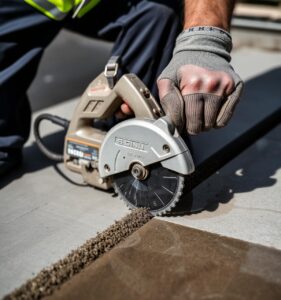
Concrete sawing uses a diamond blade – handheld, walk-behind, or track-mounted depending on the scale – to slice through slabs, walls, floors, and pavements. It’s the method you call in when you need to:
- Cut control or expansion joints in new slabs (stops random cracking down the track)
- Remove sections of a slab for renovations or demolition prep
- Cut trenches for drainage, plumbing, or services
- Create doorways or window openings in existing concrete walls
- Separate a structure before partial demolition
Unlike core drilling’s “one clean hole” approach, sawing is about removal – taking out whole chunks or strips of concrete, fast. There’s a reason road crews and big commercial sites lean on sawing: when you need to move a lot of concrete in a straight line, nothing beats it for speed.
Core Drilling vs Concrete Sawing: The Side-By-Side
Sometimes a table just says it better than I can in prose. Here’s the quick-reference version:
| Factor | Core Drilling | Concrete Sawing |
| Cut shape | Round holes only | Straight lines, joints, sections |
| Best for | Pipes, cables, ducts, anchors | Trenching, demolition prep, joints |
| Disruption level | Minimal – surrounding concrete untouched | Moderate to high – removes material |
| Noise & vibration | Low | Moderate to high (depending on saw type) |
| Speed for large jobs | Slower for big areas | Faster for long runs |
| Common diameter/depth range | 6mm–1,000mm diameter, almost any depth | Depth limited by blade/saw size |
| Typical Melbourne use case | Plumbing in a kitchen reno, HVAC in an office fit-out | Slab removal, driveway joints, trenching for drainage |
If you remember nothing else from this article, remember this: round hole = drilling, straight cut or section removal = sawing. Most projects genuinely need a mix of both at different stages, and that’s completely normal.
Why the Method You Choose Actually Matters
I get it – concrete is concrete, right? Wrong. Choosing between core drilling and sawing isn’t just a technical preference; it affects your project’s cost, timeline, and the structural integrity of what’s left behind.
Use the wrong method and here’s what can go sideways:
- Cracking – forcing a saw to do a job a core drill should handle (or vice versa) stresses the surrounding concrete
- Wasted time – sawing a single small hole is overkill; drilling a long trench is painfully slow
- Budget blowouts – the wrong equipment means more labour hours, more wear on tools, more mess to clean up
- Compliance headaches – structural penetrations often need to follow specific methods to satisfy engineering sign-off
This is exactly why experienced Melbourne concrete cutting crews don’t treat it as a coin toss. As one local concrete cutting outfit puts it, the most apparent difference between concrete cutting and core drilling lies in the tools and techniques used, as well as their applications – with cutting suited to larger openings or removal of sections, while core drilling is typically reserved for precise, round holes. That distinction guides almost every decision on site, from a small residential reno to a commercial fit-out in the CBD.
Wet vs Dry: A Quick Detour Worth Knowing
Whether you’re core drilling or sawing, you’ll often hear the terms “wet” and “dry” thrown around. Quick breakdown:
- Wet cutting/drilling: Water cools the diamond blade or bit, dramatically cuts down on dust, and usually gives a cleaner finish. The trade-off? More mess from slurry (that grey, gritty water runoff).
- Dry cutting/drilling: No water involved – used when water access is limited, or when there’s a real risk near electrical wiring. Generates more dust, so good ventilation or vacuum extraction is essential.
For most residential and commercial core drilling jobs around Melbourne, wet methods are the default – they’re simply cleaner and gentler on the equipment.
Real-World Scenarios: Which One Do You Actually Need?
Let’s make this practical. Here are the situations Melbourne homeowners and builders run into most often, and the right call for each:
Installing a New Bathroom or Laundry
You need pipe penetrations through a slab or wall. Core drilling, every time – clean, round, precise, no drama for surrounding tiles or finishes.
Putting In a New Driveway
You’ll need sawing for control joints (to stop random cracking) and potentially trenching for drainage. Drilling doesn’t come into it much here.
Renovating a Kitchen with New Plumbing or Ducted Heating
Likely both. Core drilling for the pipe and duct penetrations, sawing if you’re also removing a section of slab for new footings or services.
Demolishing Part of a Wall for an Extension
Sawing, generally combined with other demolition methods, to create clean removal lines before the heavy work begins.
Installing Security Bollards or a Flagpole
Core drilling – you need a precise, round hole at a specific depth, and nothing else will do the job as neatly.
A Word on Safety (Because Concrete Doesn’t Forgive Mistakes)
Both methods involve serious equipment, fine dust, and genuine structural risk if done badly. A few non-negotiables worth knowing, even if you’re hiring a professional:
- Reinforced concrete (with steel mesh or rebar) requires different blade and bit specifications than plain concrete
- Services like electrical wiring or gas lines must be located before any cutting or drilling begins
- Dust control isn’t optional-silica dust from dry-cutting concrete is a genuine, serious health hazard
- Structural penetrations, especially in load-bearing walls, often need an engineer’s sign-off first
This is the bit where I’ll be straight with you: this isn’t a confident-weekend-warrior job. Both core drilling and concrete sawing use industrial diamond tooling that can cause serious injury, and getting the structural assessment wrong can compromise a building. Bring in licensed professionals who do this for a living.
Cost: What Influences the Price in Melbourne?
Pricing for both core drilling and concrete sawing depends on a handful of factors:
- Concrete thickness and reinforcement – thicker, heavily reinforced concrete takes longer and costs more
- Access – tight indoor spaces or upper floors can add complexity (and price)
- Hole size or cut length – bigger diameters and longer cuts mean more time and bit/blade wear
- Wet vs dry method – wet setups sometimes cost slightly more due to water management and slurry cleanup
- Site conditions – heritage buildings, occupied premises, or out-of-hours work all affect quotes
Always get a few quotes and ask specifically whether the job needs core drilling, sawing, or a combination – a clear scope upfront avoids nasty surprises later.
For a deeper technical breakdown of methods and equipment, this concrete cutting and core drilling overview is a handy additional read.
Conclusion
So, core drilling vs concrete sawing – what’s the real takeaway? It comes down to shape and purpose. Need a clean, round hole for a pipe, cable, or anchor? Core drilling is your tool. Need to remove a section, cut a joint, or trench through a slab? Sawing wins that round.
Most serious renovation or construction projects around Melbourne will use a combination of both at different stages – and that’s not a sign you’ve planned poorly, it’s just how concrete work actually goes.
If you’re staring down a project and aren’t sure which method applies (or whether you need both), don’t guess. Get in touch with a licensed concrete cutting specialist who can assess your site, walk you through the options, and quote it properly. A five-minute phone call now beats a cracked slab later every single time.
Frequently Asked Questions
Is core drilling more expensive than concrete sawing?
It depends on the job size. Small holes via core drilling are often cheaper than sawing, but large areas favour sawing for cost-efficiency.
Can core drilling go through reinforced concrete?
Yes, with the right diamond bit. Reinforced concrete just takes longer and needs a bit rated for cutting steel mesh.
Does core drilling make a mess?
Wet core drilling creates slurry runoff, which professionals manage with vacuums or containment. Dry drilling makes more dust instead.
How thick can concrete be for core drilling?
Diamond core drills can handle most residential and commercial slab thicknesses, with bits suited to almost any practical depth.
Do I need council approval for core drilling or sawing?
Sometimes, particularly for structural work or heritage properties. Check with your builder or local council before starting.